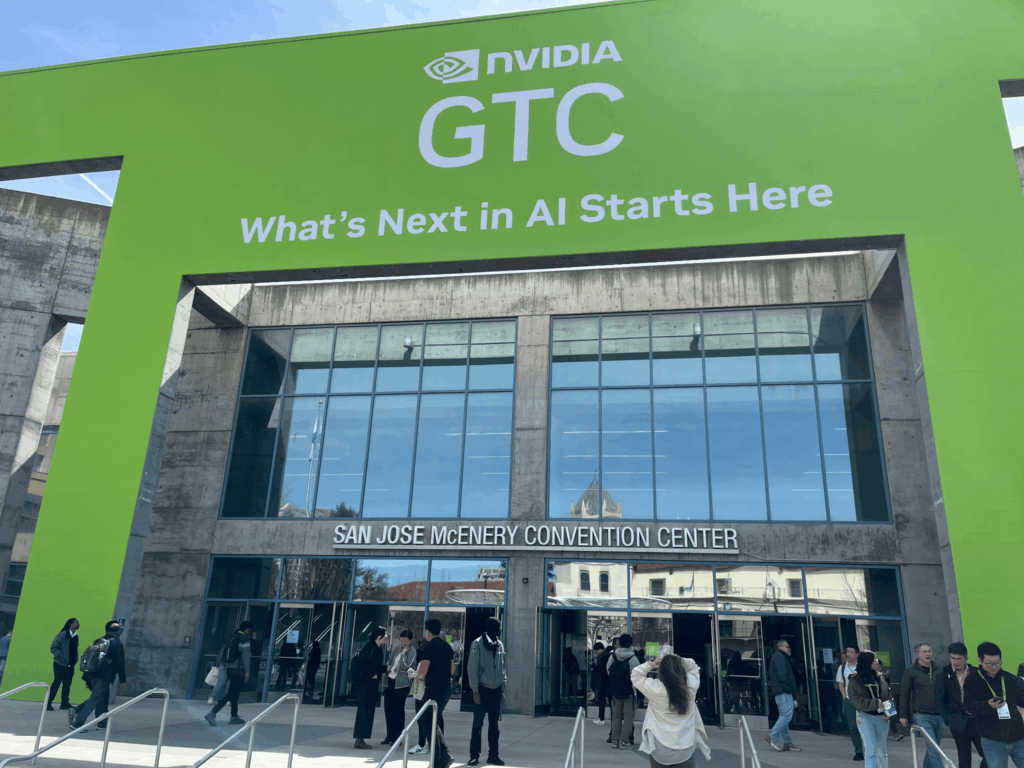
Earlier the last year I had the chance to attend the GTC in the US, so I honestly didn’t expect that just a few months later I would also get the opportunity to join its European edition, GTC Paris. This trip was a truly special experience for me, as one of our clients, Euronet, joined us as well, so we were able to experience the event together.
The European GTC was not a fully independent event, but part of the Vivatech exhibition. As such, it was smaller in scale, with fewer programs than the American “main event,” yet it still turned out to be a truly valuable experience. For us it lasted about one and a half days – but those one and a half days were packed with impressions.
Even getting there came with some excitement. What is normally a 30-minute ride from the airport took us more than an hour, since French taxi drivers happened to be on strike and the traffic was completely jammed. We were a bit worried that we might miss the keynote, but thanks to having printed our passes in advance we got in quickly and managed to find a good spot to watch Jensen Huang’s keynote speech.
The keynote had a truly unique atmosphere – it felt much more like a rock concert than a classic tech talk. True to his style, Jensen spoke without a teleprompter, in an improvised yet very energetic way. The central theme was agentic AI: the realization that artificial intelligence is no longer just about generation, but increasingly about becoming a task-performing AI – capable of planning, reasoning, and acting independently. Closely tied to this was the idea of the “AI factory,” the vision that future data centers will not only store data, but actually manufacture intelligence – a radically new perspective on infrastructure.
It was also interesting to see that several announcements – such as the Grace Blackwell (GB200) platform, the Blackwell Ultra GPU, or the DGX Spark – had already been made at the US event. In Paris these were reinforced and presented in a European context. What was truly unique, however, was the emphasis on Europe’s sovereign AI strategy: Germany launching an Industrial AI Cloud with 10,000 Blackwell GPUs, France building its own AI environment with Mistral AI on 18,000 Grace Blackwell chips, and the UK announcing a £1 billion investment into research compute capacity by 2030. Added to this were the major European telcos – Orange, Telefónica, Swisscom, and Deutsche Telekom – as well as the partnership with the EBU (European Broadcasting Union, the alliance of Europe’s public service media), which aims to use AI to support the creation, subtitling, and distribution of multilingual public media content. All of these show that Europe is taking AI sovereignty very seriously and does not intend to rely solely on external players.
What I found especially exciting was that even in our region several countries – Poland, Bulgaria, Slovakia, and Slovenia – appeared on the map as actors building their own AI factories and developing AI solutions. This is a strong signal that significant steps are being taken around us. I sincerely hope that Hungary will not be left out of this wave of development. For now I am not aware of initiatives of a similar scale, but I trust that such projects will soon be launched here as well.
The exhibition area itself was more modest than at the US GTC: fewer hardware showcases, smaller booths – but in return it offered a much more personal experience. It was easier to have longer conversations with product managers and engineers, and often real in-depth technical discussions could emerge. It was also inspiring to see European startups from the NVIDIA Inception program, and of course to join the various industry-focused sessions. Together with our client, we mainly followed the sessions related to the financial sector, which were particularly relevant for us.
Although I heard that Jensen once again walked through the booths and many had the chance to meet him in person, this time I unfortunately missed it – luckily I had that experience already at the US event earlier this year.
If I had to summarize briefly: the big US GTC at the beginning of the year was the stage for global announcements, while GTC Paris was a more focused, more intimate, Europe-themed event. It doesn’t replace the American one, but it is an excellent alternative for those who can’t make it there or want to concentrate specifically on the European market. For me, the most valuable takeaway was witnessing firsthand the rise of sovereign AI in Europe, and realizing that several Central and Eastern European countries are already moving forward on this path. This is not only inspiring but also motivating: I will use every tool at my disposal to help Hungary advance in this field, so that we too can soon join those Central European countries where NVIDIA-based AI factories and sovereign AI solutions are already taking shape.